
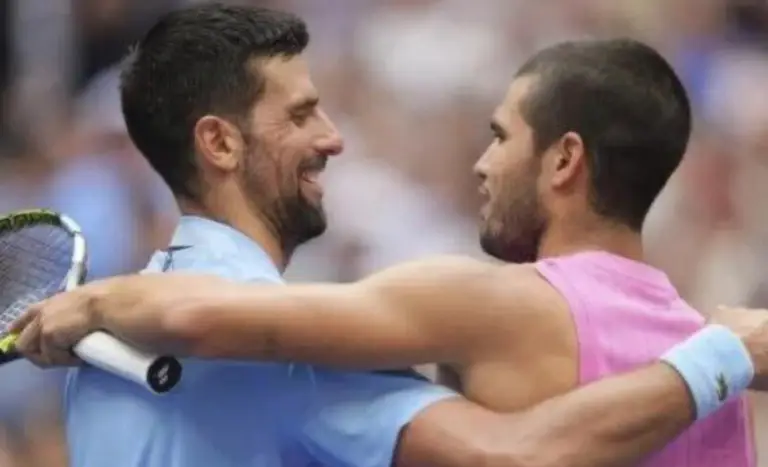
Anyone who watched sports this weekend could see it live: something is changing in the world of sports.
In the past, elite sport was often synonymous with rivalry:
In tennis:
Boris Becker vs. Michael Stich
In football:
Cristiano Ronaldo vs. Lionel Messi
In alpine skiing:
Hermann Maier vs. Stefan Eberharter
There was respect—but closeness? Friendship? Never!
Today we are seeing something new.
The very best fight fiercely on the field—and off it they are often genuine friends. They travel together, train together, exchange tips, and push each other to ever higher levels.
For example, Jannik Sinner and Carlos Alcaraz traveled together in a private jet to the Australian Open this year.
In interviews after the final between Carlos Alcaraz and Novak Djokovic, both spoke about what a privilege it is to play and train with each other. At no point did it feel like a polite cliché—it clearly came from the heart!
The same can be seen in alpine skiing. The protagonists often seem less like rivals and more like friends. That was evident again yesterday when Franjo von Allmen snatched the fastest time from long-time leader Dominik Paris. The Italian bowed to the Swiss athlete’s performance and warmly embraced him as he handed over the “red leader’s chair.”
Many people intuitively believe:
- Distance protects.
- Rivalry makes you stronger.
- Closeness weakens your advantage.
I used to think that way myself.
At the beginning of my CrossFit journey, I would go to competitions and prepare alone in a corner. I often caught myself speaking badly about my competitors—thinking: I’ll crush him today.
In the end, I often went home lonely and with poor results.
That changed the day the best athlete in my age group, Vincent Diephuis, approached me and said:
“Hi, my name is Vince. I’ve seen you quite often at the last events—do you want to exchange experiences?”I was stunned—and honestly a little ashamed.
We had a wonderful conversation and became real friends. That encounter changed me, because I experienced the power of coopetition: cooperation and competition at the same time. It works—and it helps us grow.
Why does this closeness among competitors work?
- Research shows: The mere presence of high-performing peers increases focus, intensity, and precision.
- Studies show that cooperative rivalry leads to faster learning curves and sustained peak performance.
- Those who see others not as a threat but as a source of learning develop faster.
Friendship among competitors does not mean less ambition—it means more openness and more development.
Unfortunately, in business and management I still see far more separation and rivalry than closeness:
BMW vs. Audi;
Deutsche Bank vs. UBS;
Allianz vs. AXA—just to name a few.
This post was published by Wolfgang Jenewein on LinkedIn on February 2, 2026. Zum Original-Beitrag