
An interview with Wolfgang Jenewein in HANDELSZEITUNG.
to the post
In your talks on positive leadership, you often discuss intrinsic motivation. Could you briefly explain what that is?
If someone does something with joy and passion, they enter a flow. And then they are intrinsically motivated.
How do you get employees into a flow?
Leadership theory has already defined since the 1960s what intrinsic motivation is and how to activate it. However, what science proves and what management implements doesn’t necessarily have to be the same. This gap is now slowly closing because companies are realizing they need more intrinsic motivation in their organizations. That’s why they are turning to teachings that are already twenty or thirty years old.
What has changed since then?
In the past, leadership was understood as a process, top-down, and hierarchical. Today, this is increasingly challenged by a disruptive environment and a younger generation that wants to take more shared responsibility.
How can this development in leadership be implemented?
It requires more empowerment, more opportunities for people to develop themselves. Many companies are therefore in the process of reinventing themselves.
What are the principles of positive leadership?
It’s about seeing people and – as the name suggests – approaching them in a positive way.
What does that mean in practice?
There are two mindsets: Either you see people—or employees—as difficult, assuming they only cause problems and trouble, or you are open and genuinely interested in them.
Which type do you belong to?
I believe in people. And I deeply believe that everyone can be a star in their own way. Once I know where a person’s strengths lie, I try to help them find roles in the company or team where they can use them. That is positive leadership.
Is there a concrete approach for this?
We’re talking here about the principle of Identify-Combine-Stretch. The first step is “Identify”: that means recognizing people—when are they in flow? When do they perform well? Leadership is about seeing people and their uniqueness, and thereby acknowledging their individuality. The second step is “Combine”: the potential you’ve identified is combined with other potentials. This means placing people in a new position where their abilities complement others. Finally comes “Stretch”: once the person is in the right position and can be active there, they are ready to stretch. This is achieved by giving them significant responsibility and challenging them.
Do all people react the same way to this approach?
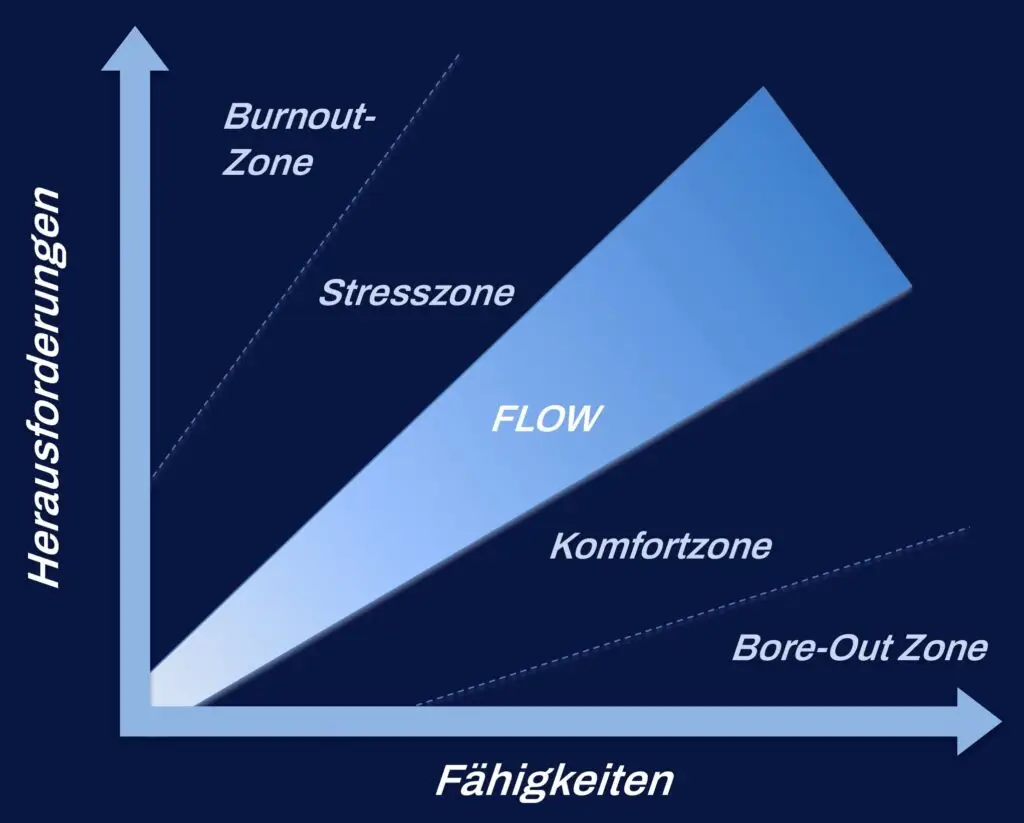
Not necessarily. There’s a simple model (see graphic): On the x-axis we have skills, on the y-axis we have challenges. If someone finds themselves in a situation with many challenges but few skills, they are in the “Panic Zone,” which can even lead to burnout, because they are constantly doing things they don’t enjoy and are constantly pushed. The second zone, with fewer challenges and more skills, is the “Stress Zone.” When we are in stress, adrenaline rises, we are under tension, and we need to stretch to meet the challenges. This leads to growth. Only prolonged stress is harmful; short-term stress helps us improve. It’s like our muscles: they only grow when we challenge them.
Flow model according to Mihaly Csikszentmihalyi (own illustration)
Where is the “Flow Zone”?
In the middle, where skills and challenges are in balance. Here, one is in the Flow Zone—motivated, improving, and enjoying the process.
Are there any other zones?
Yes, there are. One is when the skills are greater than the challenges. We humorously call this the “Popcorn Zone,” also known as the “Comfort Zone.” Finally, there’s the area where skills far exceed challenges. That’s the “Bore-out Zone.” It’s dangerous and unsustainable in the long run.
The goal is, therefore, to get someone into the “Flow Zone”?
A good leader recognizes when their employees were last in flow. Then it’s about placing these people in the right position, combining them with others, and challenging them. That is the path to high performance.
Positive leadership means helping employees grow.
Exactly. Because in the long run, every leader gets the employees they deserve. To achieve this, you need to be selective and build a team with a strong culture, flat hierarchies, and agile ways of working. This reputation spreads, and good people attract other good people.