
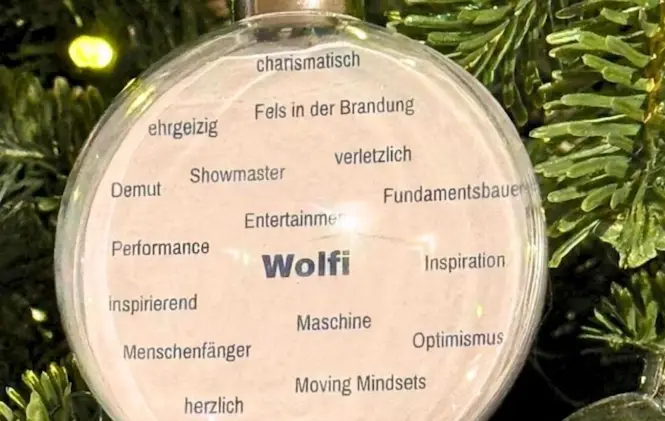
A few days ago, a beautiful idea from my team at our JENEWEIN Christmas celebration truly amazed me: every employee received a personalized Christmas ornament. The ornament itself was high-quality, but what made it even more special was that around each person’s name were all the positive qualities the team associates with them. The adjectives had been collected beforehand through an online survey. No one knew what they were for, which made it an even bigger surprise when everyone received their own ornament.
It moved me deeply to read so many kind things about myself—and believe it or not, some people even had tears in their eyes! In addition to the ornament, there was also a Christmas card, but it wasn’t addressed to the employee. Instead, it was addressed to their partner. The idea was to thank the people behind our colleagues for their support and to let them know what a great job their loved one is doing.
Why am I telling you this?
First, because it might also be a nice idea for your own Christmas celebration 😉
And second, because I believe it is a great example of the “power of appreciation.”
Research speaks of the “gratitude gap.”
80% of leaders say that gratitude is crucial for motivation and retention. Yet only 15% of employees say they regularly feel truly appreciated (CCL, 2023). This gap is not just an image problem—it mainly costs motivation, loyalty, and productivity. Because employees don’t always quit loudly. Many quit quietly: with less initiative, less creativity, and less passion.
The work psychologist Nicole Kopp recently pointed out in Neue Zürcher Zeitung that appreciation can work like a small miracle. It increases well-being and sleep quality, and also reduces stress and the risk of burnout. So why do we say thank you so rarely? Because we believe that year-end bonuses, the Christmas speech, or a promised promotion will take care of it?
Genuine appreciation cannot be delegated. It is an indelible human need—regardless of hierarchy, age, or gender—we all need it like plants need light.
It costs nothing and achieves so much when we do it right.
It happens in the moment. In conversation. In a conscious look.
Research (Grant & Gino, 2010; Emmons & McCullough, 2003) offers a clear recommendation:
1. Be concrete Only those who clearly name what they are grateful for create meaning.
2. Be timely A thank-you that comes too late loses its power.
3. Be personal. Only then does trust emerge.
By the way, when I proudly hung my Christmas ornament on our tree today, my 12-year-old son immediately asked whether my team had written those words voluntarily 😉
This post was published by Wolfgang Jenewein on LinkedIn on December 12, 2025. Zum Original-Beitrag