
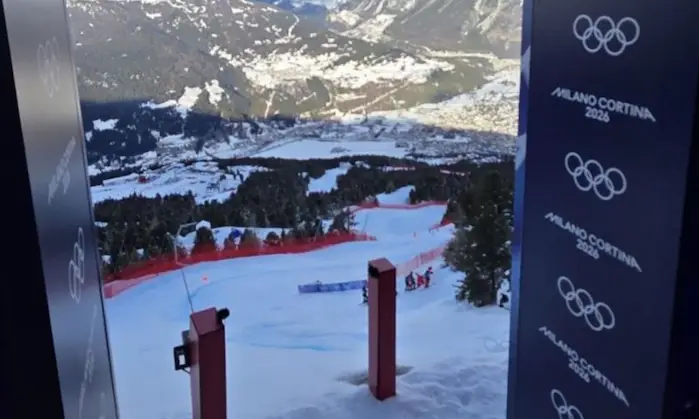
With sweaty palms and my fingers crossed, I sat there as Lindsey Vonn, at 41, launched herself out of the start gate for what was supposed to be her very last race on the infamous Tofana course.
She looked confident and focused. Wanting to gain time right from the start, she chose an aggressive line, got too close to a gate, caught it, and crashed heavily at around 60 km/h. When she finally came to a stop, the stadium fell completely silent. Only her screams could be heard through the TV monitors. I couldn’t keep watching—I was in shock. Just think about everything she had to listen to when, a year and a half ago, she decided to return to the Ski World Cup: “crazy,” “extremely dangerous,” “just a show,” “a joke.” And yet she came back.
She wanted to win at the Olympics one more time. That was her dream. She fought her way through a tough year filled with setbacks and disappointing results. Critics felt confirmed. But Lindsey didn’t give up. She learned, adapted, trained harder—and won! Lindsey Vonn showed us what is possible when you truly believe in yourself. She said:
Not “I’m too old,” but “How can I use my age?”
Not “It’s too hard,” but “It will take time and energy.”
In our organizations, we have enough people who rest on the successes of the past and keep saying that everything used to be better. What we need are people like Lindsey—people who want to get better every single day and who deeply believe that our effort and our mindset define our possibilities.
And yet, after this crash, an uncomfortable question remains:
Where do courage and determination end—and where do recklessness and negligence begin? Was it too risky to race one of the most dangerous downhill courses in the world with an acute ACL injury?
Especially when it is clear that the consequences of a crash can be far more severe for a body that is already compromised? I had a similar conversation with Aleksander Aamodt Kilde. He too is coming back from a serious injury. His dream was also to compete at the Olympics once more. He had travelled there and was ready to start! But after long conversations and honest reflection, he ultimately decided—through tears—that the risk was too great. It hurt him deeply to admit that mentally and physically he was not yet ready for such a dangerous course as the Stelvio.
It takes courage to give everything and never give up. But it may take even more courage to acknowledge your own vulnerability and recognize where boldness ends and recklessness begins.
We often celebrate only the heroes who push through at all costs. But what about the quiet heroes who realize: Not yet.
Perhaps that is the more important inspiration for the young people who look up to Olympians like Vonn and Kilde.
This post was published by Wolfgang Jenewein on LinkedIn on February 9, 2026. Zum Original-Beitrag